
 Get Pre-Qualified
 603.485.4205
  24/7 Emergency Service Request
 Frozen Pipes: The Hidden Threat in Every New Hampshire Winter
When temperatures plunge below zero in Southern New Hampshire, your home’s plumbing system enters a battle against physics. One side loses this battle every winter—and the cost is devastating. A single burst pipe can cause $10,000 to $15,000 in water damage, turn your home into a construction zone for weeks, and leave you fighting with insurance companies over coverage.
At Al Terry Plumbing & Heating, we’ve protected homes through fifty New Hampshire winters. We’ve seen the aftermath of burst pipes, and we’ve helped countless homeowners prevent them. The good news? This disaster is almost entirely preventable—if you understand what’s actually happening inside your walls.
Why Pipes Freeze: It’s Not What You Think
Most homeowners believe pipes freeze simply because it’s cold outside. That’s only half the story.
The physics of freezing: Water doesn’t freeze in your pipes just because the outdoor thermometer reads 20°F. Pipes freeze because heat is being removed from the water faster than it can be replaced. In a stagnant pipe, as water temperature drops below 32°F, ice crystals form. Here’s where the danger escalates: water expands by approximately 9% when it freezes. This expansion exerts internal pressure exceeding 2,000 to 3,000 pounds per square inch—far beyond what copper pipe or PVC can withstand.
The real culprit: Air movement: A pipe in a 20°F basement with still air might never freeze. But that same pipe exposed to a 15 mph draft from a poorly sealed rim joist will freeze rapidly. The moving air strips heat away through convection, and that’s what kills pipes.
The Stack Effect: Your Home’s Hidden Enemy
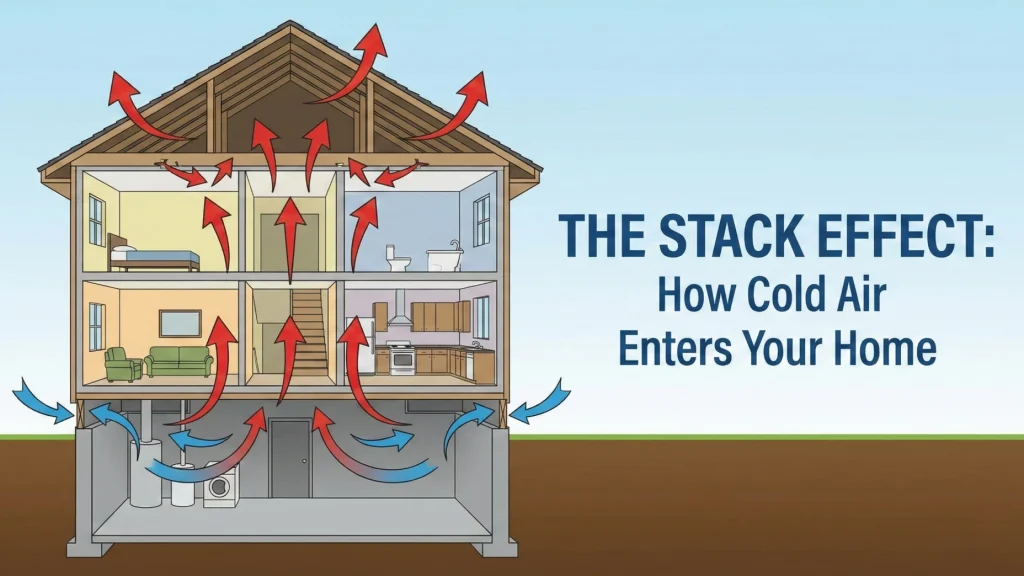
The biggest threat to your pipes isn’t the temperature outside—it’s a phenomenon called the “stack effect” happening inside your home right now.
How it works:
- Warm air rises: The heated air in your home is less dense than cold air. It naturally rises to your upper floors and attic.
- The escape: This warm air finds escape routes—gaps around recessed lights, bathroom fans, attic hatches, and chimney chases.
- The vacuum: As warm air exits the top of your house, it creates negative pressure (suction) in your lower levels.
- Cold air infiltration: To equalize this pressure, frigid outside air gets sucked into your basement and crawlspace through the path of least resistance: the rim joist.
What’s a rim joist? It’s the wooden perimeter where your house frame sits on the foundation. In homes built during the 1970s and 80s—a significant portion of New Hampshire’s housing stock—this area was often “insulated” with fiberglass batts. But here’s the problem: fiberglass is an air filter, not an air barrier. It does nothing to stop air movement.
The result: Sub-zero air rushes through your fiberglass insulation and washes over any plumbing pipes in your basement ceiling. Even though your thermostat says it’s 65°F inside, those pipes are experiencing wind chill equivalent to outdoor conditions.
The Most Vulnerable Pipes in Your Home
Not all pipes are created equal when it comes to freeze risk. Here’s where to focus your protection efforts:
High-Risk Locations:
Exterior wall pipes: Any plumbing running through exterior walls—especially on the north side of your house—is vulnerable. These pipes sit right against the cold sheathing with minimal insulation protection.
Basement ceiling pipes: Pipes running along or near rim joists face the full force of cold air infiltration from the stack effect.
Unheated spaces: Pipes in garages, crawlspaces, and unfinished attics have no heat source to buffer them against the cold.
Pipes near foundation vents: If your crawlspace has foundation vents (common in older homes), pipes near these openings face direct exposure to outdoor air.
Special Risk: Vacation Homes and Extended Absences
The most catastrophic burst pipe events happen when homeowners are away. The timeline is predictable and brutal:
- Hours 1-4: Your home’s thermal mass (the heat stored in walls, furniture, and structure) keeps things above freezing even if the heat fails.
- Hours 4-8: Interior temperature drops below 32°F.
- Hours 8+: Pipes begin to freeze. The first to go are always the most exposed—usually in the basement near rim joists or in exterior walls.
- The rupture: As ice forms and expands, the pipe splits. But here’s the insidious part: you won’t know yet. The ice is acting as a plug, preventing water flow.
- The flood: When temperatures rise or the ice shifts, water flows freely through the rupture. If you’re not home, it can flow for days before discovery.
Prevention Strategies That Actually Work
Let’s separate the effective solutions from the old wives’ tales.
Strategy 1: Let Faucets Drip (With Nuance)
Why it works: Moving water is much harder to freeze than stagnant water. A drip maintains flow and prevents ice formation.
The right way to do it:
- Identify faucets served by the most vulnerable pipes (exterior walls, unheated spaces)
- A pencil-lead-thin stream is sufficient—you don’t need a full flow
- Open both hot and cold taps slightly to protect both supply lines
- The drip should be continuous during the extreme cold period
The limitation: This is a band-aid, not a cure. It reduces risk but doesn’t eliminate it if your pipes are in truly exposed locations.
Strategy 2: Keep Cabinet Doors Open
Why it works: Bathroom and kitchen sinks often have pipes running through exterior walls. The cabinet doors trap cold air against these pipes. Opening them allows your home’s heated air to circulate around the plumbing.
Best practices:
- Open all cabinet doors under sinks on exterior walls
- If you have small children or pets, temporarily remove any hazardous cleaning supplies stored in these cabinets
- Keep these doors open throughout cold snaps, not just overnight
Strategy 3: Maintain Minimum Temperature When Away
The 55°F rule: This is the commonly cited minimum, but let’s be specific about what this really means.
Why 55°F? This provides a safety buffer. Even if your heating system cycles off for a period, the thermal mass of your home should prevent temperatures from dropping to freezing levels quickly enough to endanger pipes.
The critical caveat: This assumes your heating system is working properly. A furnace that’s been neglecting and prone to failure puts this entire strategy at risk. This is why pre-winter heating system inspections aren’t optional—they’re insurance.
Smart home advantage: Wi-Fi thermostats can alert your phone if the temperature drops below your set threshold. This gives you warning that something’s wrong before pipes freeze.
Strategy 4: Insulate Exposed Pipes
The standard advice: Wrap foam pipe insulation around vulnerable pipes in crawlspaces, basements, and attics.
The reality check: Pipe insulation slows heat loss but doesn’t prevent it. Think of it like wearing a coat outside. You’ll stay warm longer, but if you stand still in sub-zero weather long enough, you’ll still get hypothermia. Pipe insulation buys you time, but it’s not a permanent solution for pipes in unheated spaces.
The better approach: Bring the pipes into conditioned (heated) space. If pipes run through an unheated crawlspace, insulate and air-seal the crawlspace floor above, effectively creating a semi-conditioned buffer zone.
The Permanent Solutions: Fixing the Root Cause
The strategies above are all reactive—protecting pipes from an environment that’s hostile to them. The better approach is to change the environment.
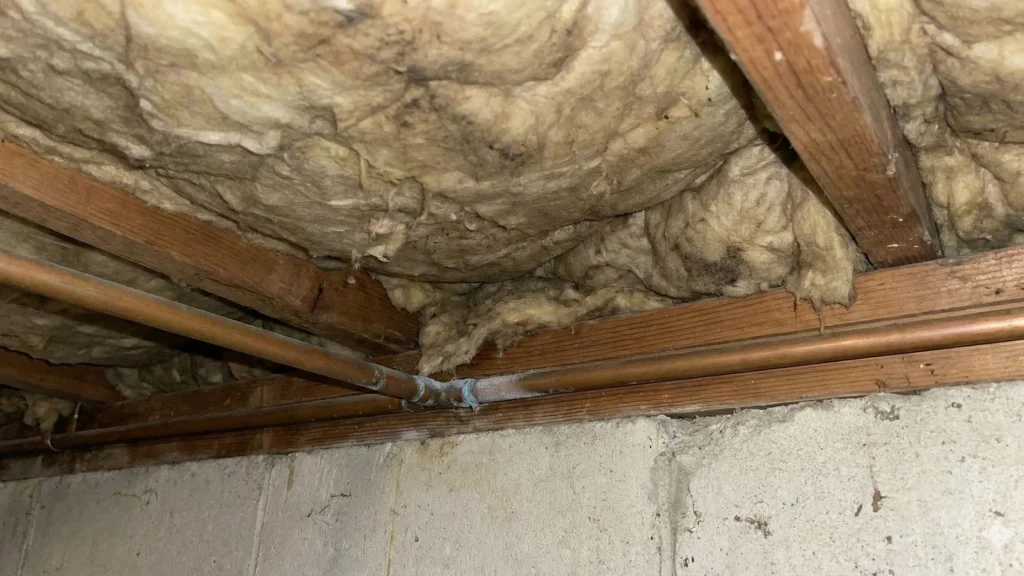
Solution 1: Air Seal the Rim Joist
This is the single most effective intervention for preventing frozen pipes in basements.
The process:
- Remove any existing fiberglass insulation from the rim joist area
- Apply two-part closed-cell spray foam or rigid foam board sealed with canned foam
- This creates an actual air barrier, stopping the cold air infiltration that causes freezing
The benefit: By cutting off the supply of sub-zero air, your basement temperature stabilizes. Pipes that once froze every winter suddenly become safe because they’re no longer in the wind.
The investment: Professional spray foam insulation for a typical basement rim joist might cost $1,500-$2,500. Compare this to the $10,000-$15,000 cost of a single burst pipe incident, and the ROI is obvious.
Solution 2: Reroute Vulnerable Pipes
For pipes in exterior walls or other impossible-to-protect locations, sometimes the only permanent solution is to move them.
Common reroutes:
- Relocating bathroom plumbing from exterior walls to interior walls during renovations
- Running new supply lines through the basement ceiling on the warm side of insulation
- Eliminating outdoor hose bibs in favor of frost-free models with the valve mechanism inside heated space
Solution 3: Heat Trace Cable (With Important Caveats)
Heat trace cable (often called “heat tape”) is an electric resistance cable that generates heat to keep pipes above freezing.
When it works: Heat trace is effective for short runs of exposed pipe where other solutions aren’t feasible—like the water line from your well to your house.
The critical failure points:
- Power outages: Heat trace requires electricity. During the blizzards that cause the coldest temperatures, power outages are common. Your heat trace fails exactly when you need it most.
- Installation errors: Overlapping heat trace cable causes hot spots that can melt pipes or start fires. Improper installation is a major fire hazard.
- Age and damage: Heat trace degrades over time. Rodents can chew through it. Regular inspection is essential.
The verdict: Heat trace is a last resort, not a primary defense. Passive protection (insulation and air sealing) is always superior because it doesn’t require power to function.
The Smart Home Era: Technology Solutions
Modern technology has revolutionized frozen pipe prevention with automated monitoring and protection systems.
Automatic Water Shut-Off Systems
Devices like the Moen Flo or Phyn Smart Water Assistant have changed the game.
How they work:
- Install on your main water line
- Monitor pressure, flow rate, and temperature 24/7
- Learn your home’s normal water usage patterns through AI
- Detect anomalies like the tiny pressure drop that signals a forming leak
The critical feature: Automatic shut-off. If the device detects catastrophic flow (like a burst pipe), it closes the main water valve automatically—even if you’re not home. This turns a $15,000 flood into a small puddle.
The cost: $400-$800 installed. Again, compare this to a single insurance deductible ($500-$2,000) plus the hassle of water damage, and these systems pay for themselves the first time they save you.
Smart Thermostats
A Wi-Fi thermostat does more than let you adjust temperature from your phone.
For frozen pipe prevention:
- Set a low-temperature alert (e.g., if your house drops below 50°F, you get a notification)
- Provides early warning of heating system failure before pipes freeze
- Some models can automatically adjust to maintain minimum temperature if they detect falling temps
Smart Leak Detectors
Small, battery-powered sensors placed near water heaters, under sinks, and in basements.
What they detect: The presence of water where there shouldn’t be any. If a pipe begins to leak, you get an alert on your phone immediately.
Strategic placement: Put these in the basement near your most vulnerable pipes. If a freeze-induced crack starts leaking, you’ll know within minutes instead of discovering it days later.
What to Do If You Suspect Frozen Pipes
Despite your best efforts, you might face a freezing situation. Here’s how to respond.
Warning Signs:
- No water flow: You turn on a faucet and nothing comes out, or just a trickle emerges
- Frost on pipes: Visible frost or ice on exposed pipes in basement or crawlspace
- Strange odors: A sewage smell can indicate a frozen drain line
- Only cold water flows: If hot water flows but cold doesn’t (or vice versa), one line is frozen
Immediate Actions:
- Call a professional immediately. Don’t wait to see if it thaws on its own. Every hour counts.
- Keep the faucet open. If you’ve identified which faucet is affected, leave it open. When the ice begins to thaw, running water will help melt the remaining ice.
- Apply gentle heat to accessible frozen sections:
- Use a hair dryer on low setting
- Wrap pipes in warm towels
- Use a space heater to warm the area (but never leave it unattended)
- NEVER use open flame, propane torch, or high heat—this can burst the pipe or start a fire
- Turn off the main water supply if you discover a leak. Every member of your household should know where this valve is located.
- Inspect all faucets. If one pipe froze, others might have too. Check every fixture.
What NOT to Do:
- Don’t wait to call for help hoping it will thaw naturally—the ice is expanding and the clock is ticking
- Don’t use any electrical heating device near standing water
- Don’t ignore the problem because you still have water at some faucets—you likely have a partial freeze that will worsen
The Insurance Question: Are You Really Covered?
Here’s a reality check many homeowners discover too late: your insurance company will only cover frozen pipe damage if you took “reasonable care” to prevent it.
What “Reasonable Care” Means:
If you’re home:
- Maintaining adequate heat (generally considered to be above 55°F minimum)
- Taking appropriate precautions during extreme cold (dripping faucets, opening cabinets)
If you’re away:
- Maintaining minimum heat (typically 55°F or higher)
- Having someone check on the property regularly
- Shutting off water and draining pipes if heat cannot be maintained
- Most importantly: Proof of regular heating system maintenance
The Documentation That Saves Claims:
An invoice for an annual heating system check-up is powerful evidence that you exercised “reasonable care.” If your heating system fails despite proper maintenance, it’s considered a “sudden and accidental” breakdown—which is covered. If you neglected maintenance and the system failed, the adjuster may rule it negligence—which isn’t covered.
The denial scenario:
- You haven’t had your furnace serviced in years
- It fails while you’re on a winter vacation
- Pipes freeze and burst
- The insurance adjuster reviews your maintenance records (or lack thereof)
- Claim denied for failure to exercise reasonable care
- You’re personally liable for $10,000-$15,000 in damages
The Economic Reality: Prevention vs. Repair
Let’s look at the actual numbers for a typical New Hampshire homeowner.
Cost of Prevention:
- Annual heating system maintenance: $150-$300
- Rim joist air sealing (one-time): $1,500-$2,500
- Smart water shutoff system (one-time): $400-$800
- Smart thermostat (one-time): $200-$300
- Pipe insulation materials (DIY): $50-$150
Total first-year investment (if doing everything): Roughly $2,800-$4,250
Cost of a Single Burst Pipe Event:
- Plumber’s emergency call: $500
- Water damage to floors, walls, insulation: $5,000-$10,000
- Mold remediation if not caught quickly: $2,000-$5,000
- Temporary lodging during repairs: $1,000-$3,000
- Insurance deductible: $500-$2,000
- Lost time, disruption, stress: Priceless
Average total cost: $10,000-$15,000 (and potentially denial of insurance coverage)
The prevention investment pays for itself the first time it saves you from disaster.
Your January Action Plan: Don’t Wait for the Next Deep Freeze
Southern New Hampshire typically sees multiple periods of extreme cold each January and February—often with temperatures staying below 10°F for days at a time. These are the periods when pipes freeze. Here’s what to do right now:
This Week:
- Locate your main water shut-off valve. Make sure every adult in your household knows where it is and how to operate it.
- Identify your vulnerable pipes. Walk your basement and note any pipes near exterior walls or rim joists. Check for pipes in unheated garages or crawlspaces.
- Check your rim joist insulation. Look for dirty, compressed, or missing fiberglass. If you see daylight or feel a draft, you have a problem.
- Test your heat. Make sure your furnace or boiler is operating properly. Strange noises, short cycling, or uneven heating are red flags.
- Review your insurance policy. Know what’s covered and what “reasonable care” provisions require.
Before the Next Cold Snap:
- Schedule heating system maintenance if you haven’t had service this season.
- Insulate accessible vulnerable pipes with foam pipe insulation as a temporary measure.
- Consider a smart water shutoff system for permanent protection.
- Create a cold-weather checklist: Include dripping faucets, opening cabinets, and checking that heat is maintaining proper temperature.
If You’re Going Away in Winter:
- Set thermostat to at least 55°F (we recommend 60°F for extra margin).
- Have a trusted neighbor or friend check your home every 24-48 hours.
- Consider shutting off water if you’ll be gone for extended periods and can’t guarantee heat.
- Install a smart thermostat that will alert you to temperature drops.
Why 50 Years of Experience Matters
At Al Terry Plumbing & Heating, we’ve responded to frozen pipe emergencies in every type of New Hampshire home—from Colonial-era farmhouses to modern construction. We’ve insulated thousands of rim joists, rerouted vulnerable plumbing, and thawed countless frozen pipes before they burst.
What we’ve learned:
- Every home has unique vulnerabilities based on its construction era, orientation, and exposure
- The homes most at risk are often those built during the 1970s-1980s construction boom—exactly the span of our fifty-year history
- Prevention is always cheaper than repair, and permanent solutions beat temporary fixes
- The warning signs are usually visible weeks before pipes actually freeze
Don’t Gamble This Winter
The next deep freeze is coming—it always does in New Hampshire. The question is whether your pipes are ready for it.
If you have exposed pipes in vulnerable locations, drafty rim joists, or concerns about your home’s protection, don’t wait until you’re discovering water damage. Let us assess your home’s specific vulnerabilities and implement the permanent solutions that will protect you through this winter and every winter to come.
Concerned about frozen pipes? Call Al Terry Plumbing & Heating at 603-485-4205 or visit our website to schedule a home protection assessment. Our Diamond Club members receive priority emergency service—if you do face a freezing situation, you go to the front of the line.
If you suspect frozen pipes right now, call us immediately. Early intervention can prevent a burst and save you thousands in water damage.
Stay warm, stay protected.
More Practical Home Advice You Can Trust
Our homes face unique challenges in New Hampshire’s climate. These articles break down heating, plumbing, and electrical topics in plain language—helping you understand what matters, what can wait, and how to protect your home through every season.
Well Water Season: Should Your NH Home Get a Summer Water Test?
For many New Hampshire homeowners, well water is part of everyday life. You turn on the tap, fill a glass, run the shower, water the garden, and assume the water coming from your private well is safe. But unlike town or city water, private wells are not monitored by a municipal water department. That responsibility…
Why Your Home Feels Sticky When It Is Not Hot Outside
New Hampshire weather has a way of confusing your home’s comfort system One day it is cool enough to leave the windows closed. The next day the house feels damp, sticky, and uncomfortable — even though the thermostat says it is only 68 or 70 degrees inside. That is one of the most common shoulder-season…
Why Your Upstairs Is Always Hotter Than the Living Room
If you own a two-story Colonial in southern New Hampshire, this may sound familiar: The living room feels fine. The thermostat says the AC is working. But the upstairs bedrooms are still warm, sticky, and uncomfortable. By bedtime, the second floor can feel 6, 8, or even 10 degrees hotter than the first floor. The…
Ductless Mini-Splits for Older NH Homes Without Ductwork
Older New Hampshire homes have a lot of character. They also have a comfort challenge. Many Colonials, Capes, farmhouses, and mid-century homes were built around boilers, radiators, or hot-water baseboard heat. Those systems can keep a home warm, but they were not designed for central air conditioning. In many older homes, there simply is not…
Outdoor GFCI Outlets: Why Weatherproof Protection Matters for NH Homes
Outdoor power is something most homeowners use without thinking much about it. You plug in holiday lights. Run a power washer. Charge yard tools. Power patio speakers. Use landscape lighting. Maybe you have an outdoor kitchen, pool equipment, irrigation controls, or smart devices around the house. But outdoor electricity has to deal with conditions indoor…
Why NH Pollen Is Hitting Your HVAC System Harder This Year
If it feels like pollen season is worse than usual this spring, you’re not imagining it. Across New Hampshire, homeowners are dealing with heavy tree pollen from oak, maple, and ash. Most people think of pollen as an allergy problem. Sneezing, itchy eyes, congestion. But what many homeowners do not realize is that pollen can…
Should You Shut Your Boiler Off for Spring in NH?
When the weather starts warming up in New Hampshire, a lot of homeowners start asking the same question: Should I shut my boiler off for the season, or leave it running? The honest answer is that it depends on your system. For many homes, mid-to-late April is the right time to stop using the heating…
Tired of High Electric Bills in Southern NH? Start With These Smart Upgrades
If your electric bill in Southern New Hampshire has been climbing, you are not imagining it. Between high regional electricity costs, older homes that leak heated or cooled air, and HVAC systems working harder than they should, many homeowners are paying more every month than necessary. The good news is that lowering your bill does…
Low Water Pressure in Spring? 5 Plumbing Problems NH Homeowners Shouldn’t Ignore
When spring finally shows up in New Hampshire, most homeowners are ready to open windows, clean up the yard, and put winter behind them. But for your plumbing system, spring can be one of the toughest times of year. As frost leaves the ground, snowmelt saturates the soil, municipal crews begin hydrant flushing, and aging…

How Your HVAC and Plumbing Systems Can Help Fight Spring Allergies
Spring is a welcome change in Southern New Hampshire. The snow melts, the windows start to open, and the air finally feels lighter. But for many homeowners, spring also brings sneezing, congestion, itchy eyes, and poor indoor air quality. Most people think of spring allergies as an outdoor problem. In reality, your home’s HVAC and…

Our Commitment to Your
PEACE OF MIND
5-year warranty on all new installations
AND 2-year warranty on all repairs!