
 Get Pre-Qualified
 603.485.4205
  24/7 Emergency Service Request
 Why Your Upstairs Is Always Hotter Than the Living Room
If you own a two-story Colonial in southern New Hampshire, this may sound familiar:
The living room feels fine. The thermostat says the AC is working. But the upstairs bedrooms are still warm, sticky, and uncomfortable.
By bedtime, the second floor can feel 6, 8, or even 10 degrees hotter than the first floor. The kids have fans pointed at their beds. The primary bedroom never cools down. And every summer, you wonder whether the air conditioner is too small.
Sometimes the AC is the problem.
But in many 1990s and 2000s Colonials, the issue is not the outdoor AC unit. It is the duct system.
At Al Terry Plumbing, Heating, Air Conditioning, and Electric, we see this all the time in New Hampshire homes. Hot upstairs rooms are often caused by a mix of duct leakage, poor attic duct insulation, undersized returns, high static pressure, and airflow imbalance. Some fixes can be handled during a service visit. Others require a real ductwork project.
The key is knowing the difference before you spend money in the wrong place.
Why the Upstairs Gets So Hot
Warm air rises. Cool air sinks.
That sounds simple, but it matters a lot in a two-story Colonial. The stairwell acts like a chimney inside the home. Heat naturally collects upstairs, while cooler air settles downstairs near the thermostat.
That means the first floor may satisfy the thermostat before the second floor ever gets enough cooling.
The attic makes the problem worse.
On a hot July afternoon, the attic above those bedrooms can get extremely hot. If the second-floor ceiling is under-insulated, poorly air sealed, or surrounded by leaky ductwork, the bedrooms are being heated from above while the AC is trying to cool them from below.
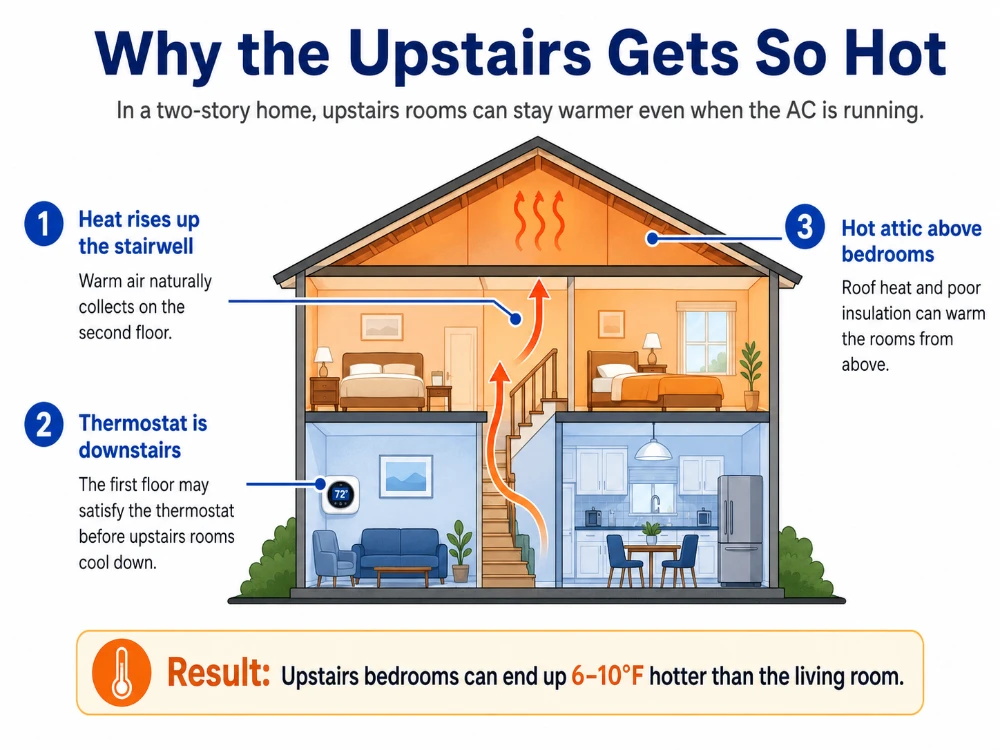
That is why the problem often shows up most clearly at night. The sun has been baking the roof all day, bedroom doors are closed, and the AC is being controlled by a thermostat downstairs.
Why 1990s and 2000s Colonials Have This Problem
Many homes built during that period were designed for speed, square footage, and clean-looking floor plans.
Ductwork was often routed through attics, tight chases, and long runs because those areas were available. That made construction easier, but it created comfort problems later.
In a perfect world, conditioned air would move through ducts located inside the conditioned part of the house. In many Colonials, some of the most important duct runs are in an unconditioned attic — one of the hottest places in the home during cooling season.
That creates two big problems:
- The air can warm up before it reaches the bedroom.
- The air can leak into the attic before it reaches the bedroom.
If your AC is making 55-degree air, but that air has to travel through a long attic run surrounded by intense heat, it may arrive at the bedroom register much warmer than it should. If the duct is also leaking, some of that cooling never reaches the room at all.
That is where ductwork leak repair can make a real difference.
Duct Leakage: The Cooling You Paid For But Never Feel
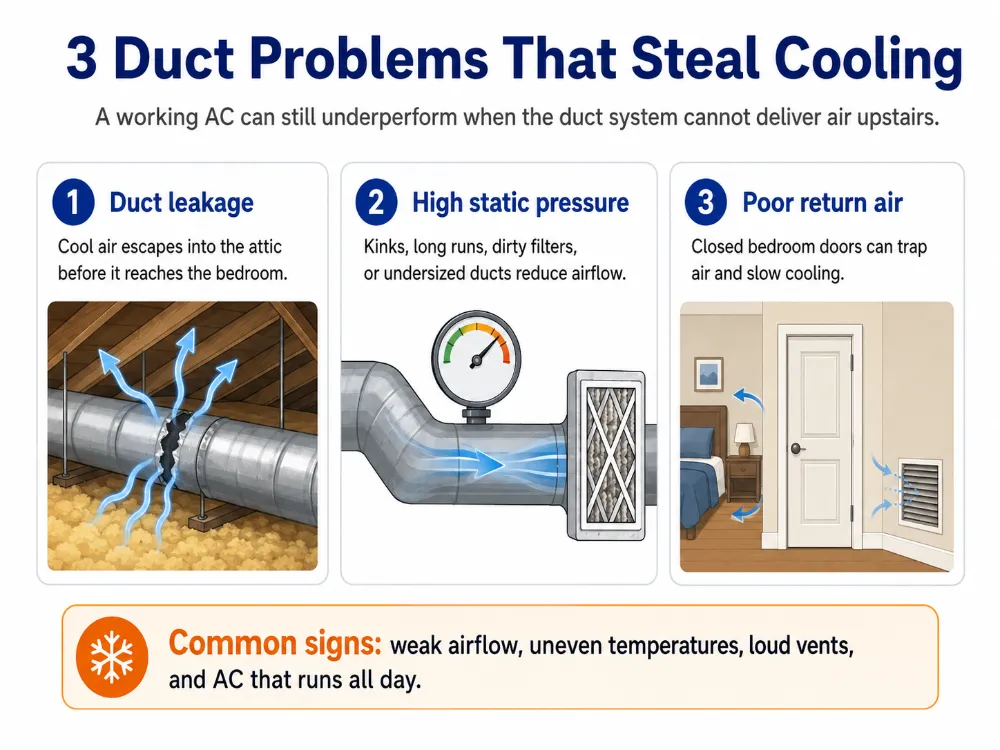
Duct leakage is exactly what it sounds like: conditioned air escaping through gaps, loose joints, disconnected sections, or damaged flex duct.
When ducts run through a basement inside the home, some leakage may still stay within the house. It is not ideal, but the cooling is not completely lost.
When ducts leak in an attic, the problem is much bigger.
That cooled air is dumped into a hot, unconditioned space instead of the bedroom. At the same time, the house can be pulled into a pressure imbalance that draws hot, humid outdoor air inside through small gaps around the building.
So the AC has to work harder in two ways:
It loses cold air before it gets to the room.
It also has to remove the heat and humidity being pulled back into the house.
That is why a homeowner may say, “The AC runs all day, but the upstairs never catches up.” The equipment may be running. The duct system may not be delivering.
Static Pressure: The Hidden Airflow Problem
Static pressure is one of the most important things homeowners rarely hear about.
Think of it like blood pressure for your HVAC system. It tells a technician how hard the blower has to work to move air through the ductwork.
When static pressure is too high, airflow drops. The rooms farthest from the system — often upstairs bedrooms — are usually the first to suffer.
Common causes include:
- Sagging or kinked flexible ductwork
- Long duct runs with too many bends
- Poorly installed fittings
- Dirty blower wheels or coils
- Restrictive air filters
- Undersized return ducts
- Closed or poorly adjusted dampers
A homeowner may notice weak air from upstairs registers, whistling vents, loud returns, uneven temperatures, or an AC system that seems to run constantly.
This is why replacing the outdoor AC unit is not always the answer. A new condenser cannot overcome a duct system that is leaking, restricted, or starved for return air.
Return Air Problems: Why Closed Bedroom Doors Matter
A forced-air system has to supply air and return air.
If the system pushes cool air into a bedroom, that same amount of air needs a path back to the return side of the HVAC system. In many Colonials, there is one central return in the hallway, stairwell, or first floor.
That can work poorly when bedroom doors are closed.
At night, the supply register may be trying to push cool air into a closed bedroom. But if there is no return grille in that room and no good transfer path back to the hallway, the room becomes pressurized. Airflow slows down. The room feels stale and warm.
This is why a room can feel better with the door open and worse with the door closed.
Door undercuts sometimes help a little, but they are often not enough. Larger return paths, transfer grilles, jumper ducts, or dedicated return ductwork may be needed to fix the pressure problem properly.
What Can Be Fixed in One Visit?
Not every hot-upstairs problem requires a major duct renovation.
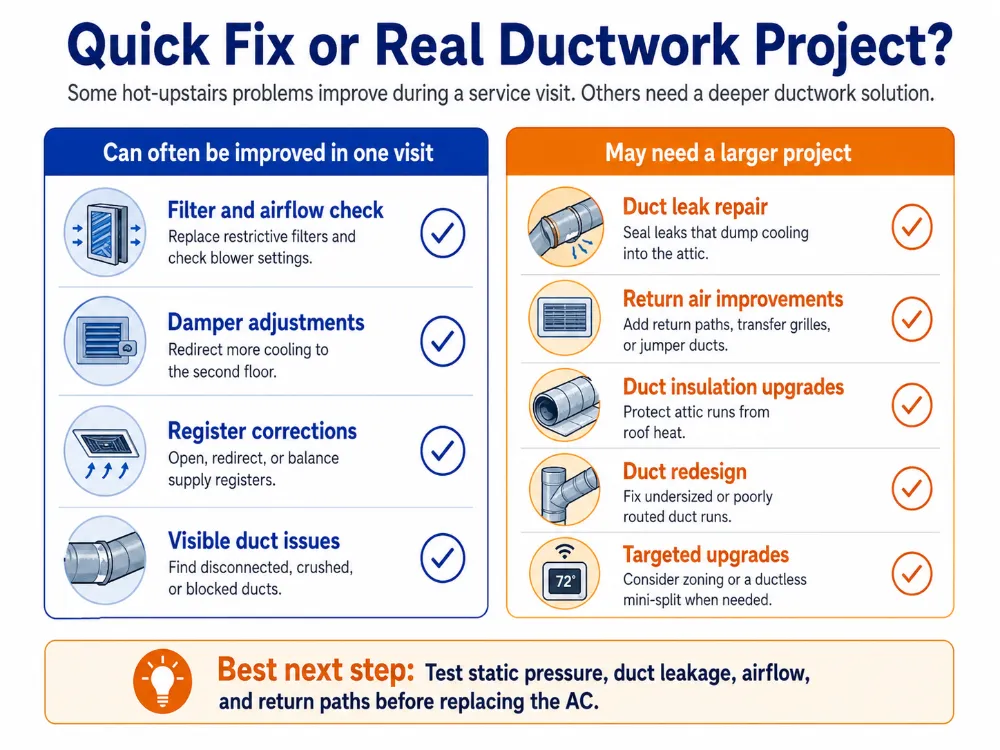
A good diagnostic visit can often uncover simple issues that are making the problem worse. Depending on the home and equipment, a technician may be able to make improvements such as:
- Replacing a restrictive or dirty filter
- Checking blower speed settings
- Inspecting dampers and adjusting airflow
- Partially reducing airflow to over-cooled first-floor areas
- Opening or redirecting upstairs registers
- Checking for obvious disconnected or crushed ductwork
- Cleaning or identifying airflow restrictions
- Confirming the AC is actually producing the right temperature drop
- Looking for thermostat or control issues
Sometimes these changes are enough to make the upstairs more livable.
For example, if the system has balancing dampers in the basement, a technician may be able to redirect more air upstairs. If a high-MERV filter is choking an older system, switching to the right filter can improve airflow. If the AC is short-cycling because the downstairs cools too quickly, fan settings and thermostat strategy may help circulate air more evenly.
These are the best-case scenarios: low disruption, lower cost, and immediate improvement.
But they do not fix every home.
When It Becomes a Real Ductwork Project
If the upstairs is still hot after basic balancing and service, the duct system may need deeper attention.
That can include ductwork leak repair, return air improvements, duct insulation upgrades, or redesigning sections of the duct system that were never moving enough air in the first place.
Signs you may be looking at a larger ductwork project include:
- Weak airflow from multiple upstairs registers
- Ducts running through a very hot attic
- Visible gaps, loose connections, or damaged flex duct
- Rooms that change temperature dramatically when doors close
- Loud return grilles or whistling vents
- A system that freezes up or struggles with airflow
- Big temperature differences between floors even after AC service
- An upstairs that never catches up no matter how long the AC runs
In these cases, the right question is not, “Do I need a bigger AC?”
The better question is, “Is the duct system delivering the cooling I already have?”
Manual Duct Sealing vs. More Advanced Duct Sealing
Some duct leaks can be sealed manually.
A technician may use approved mastic or foil-backed HVAC tape on accessible joints, seams, and connections. This can be a good option when the problem areas are visible and reachable.
The limitation is access.
In a finished Colonial, many ducts may be hidden behind drywall, above ceilings, or inside tight chases. A technician can only manually seal what they can physically reach.
For some homes, advanced duct sealing methods may be considered. These systems seal leaks from inside the ductwork by pressurizing the duct system and allowing sealant particles to collect at leakage points. The advantage is that hidden leaks can often be addressed without opening walls or ceilings.
The best choice depends on the home, the leakage level, the duct layout, accessibility, and budget. A proper evaluation should come before any recommendation.
What About Adding Returns?
If the upstairs bedrooms have supply registers but no good return path, duct sealing alone may not solve the comfort issue.
The system still needs air to move in a loop.
Possible solutions include:
- Adding dedicated return ducts to key bedrooms
- Installing transfer grilles
- Installing jumper ducts between bedrooms and hallway areas
- Improving central return sizing
- Correcting return-side restrictions
This kind of work is especially useful when rooms feel much warmer with doors closed. It can also help reduce pressure problems that make the whole system work harder.
Do Zoning Dampers Help?
Zoning can help in the right home.
A zoned system uses motorized dampers and separate thermostats to send more cooling where it is needed. For example, the upstairs zone can call for cooling even when the first floor is already comfortable.
But zoning is not a magic fix for bad ductwork.
If the ducts are leaking, undersized, crushed, or already struggling with high static pressure, adding motorized dampers can make airflow problems worse. Zoning works best when the duct system is healthy enough to handle it.
That is why the ductwork should be evaluated before zoning is recommended.
When a Ductless Mini-Split Makes More Sense
Sometimes the most practical fix is not forcing the central system to do everything.
A ductless mini-split can be a strong option for a hot primary bedroom, bonus room, finished attic space, or second-floor area that the central AC cannot serve well.
Mini-splits do not rely on long attic duct runs. They cool the room directly. They also provide room-by-room control, which can be useful when one bedroom is the real problem area.
That does not mean every hot upstairs needs a mini-split. But in homes where the ductwork is very limited, inaccessible, or expensive to redesign, a ductless solution may be the cleaner and more efficient path.
Should You Replace the AC?
Maybe. But not first.
If the air conditioner is old, low on refrigerant, poorly maintained, or not producing proper cooling, it should be repaired or replaced as needed.
But if the AC is cooling properly and the upstairs is still hot, replacing the outdoor unit may not fix the comfort problem.
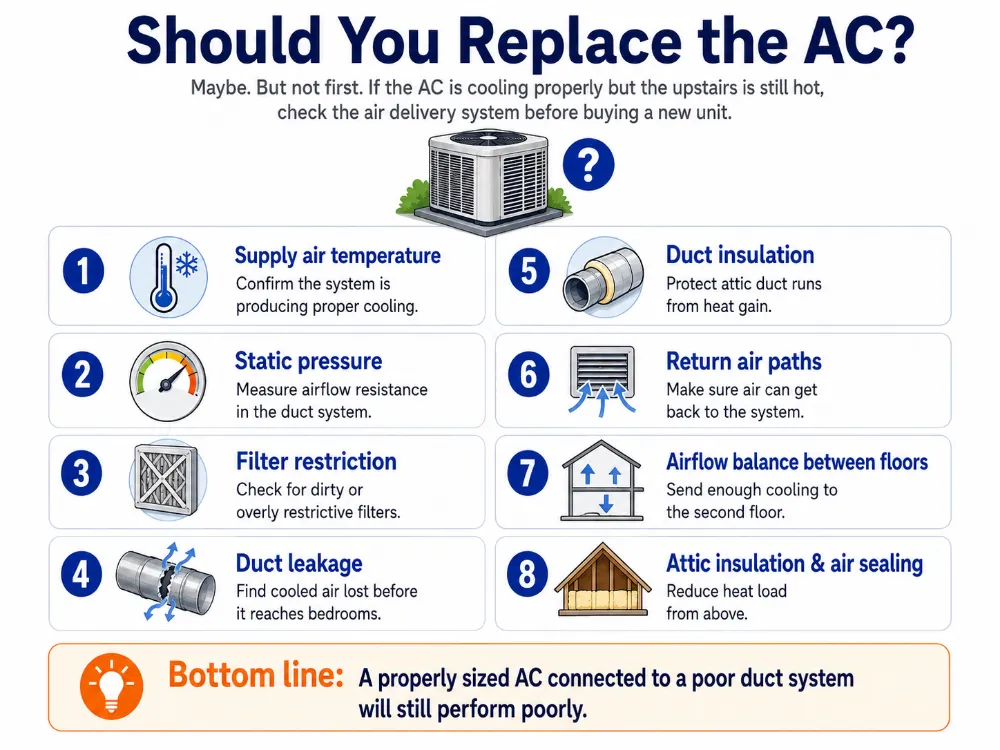
Before investing in a new system, it is worth checking:
- Supply air temperature
- Static pressure
- Filter restriction
- Duct leakage
- Duct insulation
- Return air paths
- Airflow balance between floors
- Attic insulation and air sealing
A properly sized AC connected to a poor duct system will still perform poorly.
Rebates and Incentives May Help
New Hampshire homeowners may have access to utility rebates through NHSaves for certain qualifying heating, cooling, insulation, and weatherization improvements. Program details change, and eligibility depends on the equipment, utility provider, installation date, and current funding.
That is why it is important to verify rebates before building your project budget.
For some homes, the smartest comfort plan may combine HVAC work with air sealing, attic insulation, or a heat pump upgrade. Improving the home itself can reduce the load on the HVAC system and make upstairs rooms easier to control.
The Bottom Line
If your upstairs bedrooms are always hotter than the living room, do not assume the AC is too small.
In many southern New Hampshire Colonials, the real problem is the air delivery system: leaking ducts, hot attic runs, undersized returns, high static pressure, poor balancing, or closed-door pressure problems.
Some fixes are simple. A filter change, damper adjustment, register correction, or blower setting may help during one visit.
Other fixes require a real ductwork project. That may mean ductwork leak repair, better return air, duct insulation, duct redesign, zoning, or a targeted ductless mini-split.
The right answer starts with testing, not guessing.
Al Terry Plumbing, Heating, Air Conditioning, and Electric has served New Hampshire and southern Maine since 1976. If your upstairs bedrooms are uncomfortable every summer, schedule an HVAC evaluation with Al Terry and find out what is actually fixable before another July of box fans and sleepless nights.
More Practical Home Advice You Can Trust
Our homes face unique challenges in New Hampshire’s climate. These articles break down heating, plumbing, and electrical topics in plain language—helping you understand what matters, what can wait, and how to protect your home through every season.

Why Your Upstairs Is Always Hotter Than the Living Room
If you own a two-story Colonial in southern New Hampshire, this may sound familiar: The living room feels fine. The thermostat says the AC is working. But the upstairs bedrooms are still warm, sticky, and uncomfortable. By bedtime, the second floor can feel 6, 8, or even 10 degrees hotter than the first floor. The…
Ductless Mini-Splits for Older NH Homes Without Ductwork
Older New Hampshire homes have a lot of character. They also have a comfort challenge. Many Colonials, Capes, farmhouses, and mid-century homes were built around boilers, radiators, or hot-water baseboard heat. Those systems can keep a home warm, but they were not designed for central air conditioning. In many older homes, there simply is not…
Outdoor GFCI Outlets: Why Weatherproof Protection Matters for NH Homes
Outdoor power is something most homeowners use without thinking much about it. You plug in holiday lights. Run a power washer. Charge yard tools. Power patio speakers. Use landscape lighting. Maybe you have an outdoor kitchen, pool equipment, irrigation controls, or smart devices around the house. But outdoor electricity has to deal with conditions indoor…
Why NH Pollen Is Hitting Your HVAC System Harder This Year
If it feels like pollen season is worse than usual this spring, you’re not imagining it. Across New Hampshire, homeowners are dealing with heavy tree pollen from oak, maple, and ash. Most people think of pollen as an allergy problem. Sneezing, itchy eyes, congestion. But what many homeowners do not realize is that pollen can…
Should You Shut Your Boiler Off for Spring in NH?
When the weather starts warming up in New Hampshire, a lot of homeowners start asking the same question: Should I shut my boiler off for the season, or leave it running? The honest answer is that it depends on your system. For many homes, mid-to-late April is the right time to stop using the heating…

Tired of High Electric Bills in Southern NH? Start With These Smart Upgrades
If your electric bill in Southern New Hampshire has been climbing, you are not imagining it. Between high regional electricity costs, older homes that leak heated or cooled air, and HVAC systems working harder than they should, many homeowners are paying more every month than necessary. The good news is that lowering your bill does…
Low Water Pressure in Spring? 5 Plumbing Problems NH Homeowners Shouldn’t Ignore
When spring finally shows up in New Hampshire, most homeowners are ready to open windows, clean up the yard, and put winter behind them. But for your plumbing system, spring can be one of the toughest times of year. As frost leaves the ground, snowmelt saturates the soil, municipal crews begin hydrant flushing, and aging…

How Your HVAC and Plumbing Systems Can Help Fight Spring Allergies
Spring is a welcome change in Southern New Hampshire. The snow melts, the windows start to open, and the air finally feels lighter. But for many homeowners, spring also brings sneezing, congestion, itchy eyes, and poor indoor air quality. Most people think of spring allergies as an outdoor problem. In reality, your home’s HVAC and…
Why March Is the Smartest Time to Service Your AC in New Hampshire
Why March Is the Smartest Time to Service Your AC in New Hampshire Most homeowners in New Hampshire do not think about air conditioning in March. They are still thinking about snowbanks, muddy driveways, and one more spike in the heating bill. But that is exactly why March is such a smart time to look…

Sump Pump Season Prep | Prevent Basement Flooding This Spring
Spring in Southern New Hampshire brings two things homeowners can count on: melting snow and heavy rain. That combination puts serious pressure on your home’s foundation, especially if water collects around the basement and your sump pump is not ready to handle it. Your sump pump is one of the most important lines of defense…

Our Commitment to Your
PEACE OF MIND
5-year warranty on all new installations
AND 2-year warranty on all repairs!