
 Get Pre-Qualified
 603.485.4205
  24/7 Emergency Service Request
 Why Your Home Feels Sticky When It Is Not Hot Outside
New Hampshire weather has a way of confusing your home’s comfort system
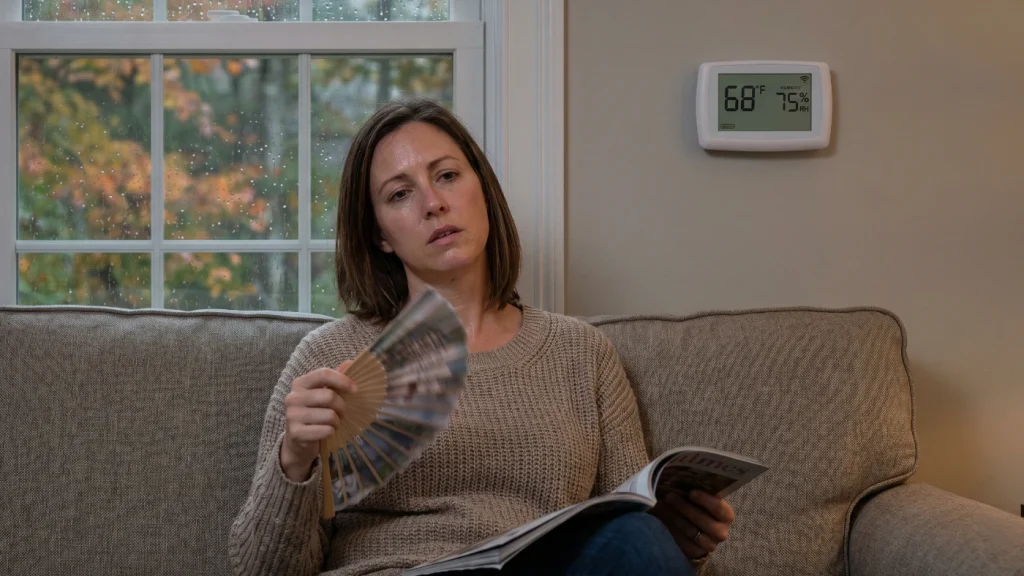
One day it is cool enough to leave the windows closed. The next day the house feels damp, sticky, and uncomfortable — even though the thermostat says it is only 68 or 70 degrees inside.
That is one of the most common shoulder-season comfort problems in New England. It often happens in spring and fall, when outdoor temperatures are mild but humidity is high. Your home may not be hot enough to need air conditioning, but it can still be humid enough to feel uncomfortable.
For many homeowners, the first instinct is to turn on the AC. But that is not always the best solution. In some cases, running central air conditioning during mild weather can leave the house feeling cold and clammy, and it may put unnecessary stress on the equipment.
The real issue may not be temperature.
It may be moisture.
Why Your House Can Feel Humid at 65 Degrees
Air conditioning is designed mainly to remove heat. It does remove moisture too, but only when it runs long enough.
That matters because New Hampshire spring and fall weather often creates a strange indoor comfort problem. Outdoor temperatures may sit in the 50s or 60s, while rain, damp soil, melting snow, coastal air, or cloudy weather keep moisture levels high.
So your home may not need much cooling, but it still needs drying.
The research behind this article describes this as the “sticky but not hot” problem. During New England shoulder seasons, homes can have very little heat load but a significant moisture load. That means the thermostat may be satisfied, while the indoor air still feels heavy and damp.
This is especially common in:
- Older homes with stone, block, or fieldstone foundations
- Homes with damp basements or crawl spaces
- Well-insulated newer homes that do not heat up easily
- Homes with limited ventilation
- Homes near the coast or low-lying wet areas
- Homes where the AC is oversized or short cycling
When the air inside your home carries too much moisture, comfort drops quickly even if the temperature looks normal.
Why Turning on the AC Does Not Always Fix It
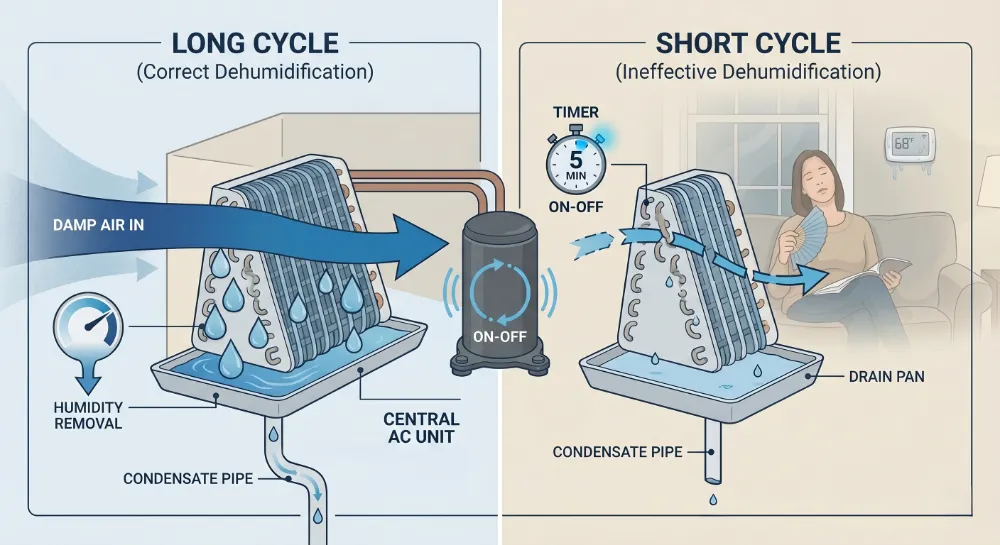
Your central air conditioner removes moisture when warm indoor air passes over a cold evaporator coil. Moisture condenses on that coil and drains away through the condensate system.
But this process takes time.
If your AC only runs for a few minutes, it may cool the air before it has enough time to remove much humidity. This is called short cycling.
That is why a house can end up feeling colder, but still damp.
You may notice:
- The thermostat reaches the set temperature quickly
- The AC turns on and off often
- Rooms feel cold but clammy
- The air feels heavy or stale
- Windows or basement areas feel damp
- The system runs but comfort does not improve
In mild weather, the AC does not have enough heat to remove from the house. It satisfies the thermostat too quickly, shuts off, and leaves much of the moisture behind.
Why Running AC in Cool Weather Can Be Hard on the System
Many homeowners do not realize that central air conditioners are not meant to run in all outdoor temperatures.
Running a standard residential AC system when it is too cool outside can create problems. The research notes that using air conditioning below roughly 60 to 65 degrees can increase the risk of short cycling, coil freezing, compressor stress, and poor moisture removal.
That does not mean every system fails the moment the temperature dips. But it does mean your AC is being asked to do a job it was not really designed to do.
Possible issues include:
Short cycling
The system starts and stops repeatedly. This can increase wear on the compressor and electrical components.
Frozen evaporator coil
If coil temperatures drop too low, moisture can freeze instead of draining away. Once ice forms, airflow and cooling performance can get worse quickly.
Cold, clammy air
The system may lower the temperature without removing enough humidity.
Higher energy use for poor results
You may be paying to run the AC without solving the real comfort problem.
For a homeowner, the simple version is this:
Your AC is good at cooling a hot house. It is not always good at drying a mild, damp house.
The Difference Between Cooling and Dehumidifying
Temperature and humidity are connected, but they are not the same problem.
Cooling lowers the air temperature.
Dehumidifying removes water vapor from the air.
In July, your AC may do both because the system runs long enough during hot weather. But in April, May, September, or October, the house may not be warm enough for long AC cycles. That is when humidity can build up indoors.
This is why a thermostat alone does not always tell the full story.
A home can be 70 degrees and comfortable.
A home can also be 70 degrees and sticky.
The difference is often indoor relative humidity.
A good target for many homes is roughly 30% to 50% indoor relative humidity. Once indoor humidity regularly climbs above 60%, the home may feel uncomfortable and can become more inviting to mold, mildew, dust mites, musty odors, and moisture damage.
Signs Your Home Has a Humidity Problem
You may need better moisture control if you notice:
- Rooms feel sticky even when they are not hot
- The basement smells musty
- Wood floors or doors swell
- Windows show condensation
- The AC turns on and off quickly
- The home feels cold and clammy after running the AC
- Allergy symptoms seem worse indoors
- You see mildew in bathrooms, closets, or basement areas
- Stored items in the basement feel damp
- Your thermostat says the temperature is fine, but the house still feels uncomfortable
These signs do not always mean you need a whole-house dehumidifier. But they are strong clues that humidity should be checked.
Why Portable Dehumidifiers Only Go So Far
Portable dehumidifiers can help in one room or one damp basement area. They are often a good first step.
But they have limits.
They usually only treat the air close to the unit. They can be noisy. They require buckets to be emptied unless they are connected to a drain. They may not move enough air to help the entire house.
A portable unit may help a basement corner.
A whole-house dehumidifier is designed to manage moisture across much more of the home.
How a Whole-House Dehumidifier Works
A whole-house dehumidifier is installed as part of your home comfort system. Instead of relying on the AC to remove moisture as a side effect, it is designed specifically to dry the air.
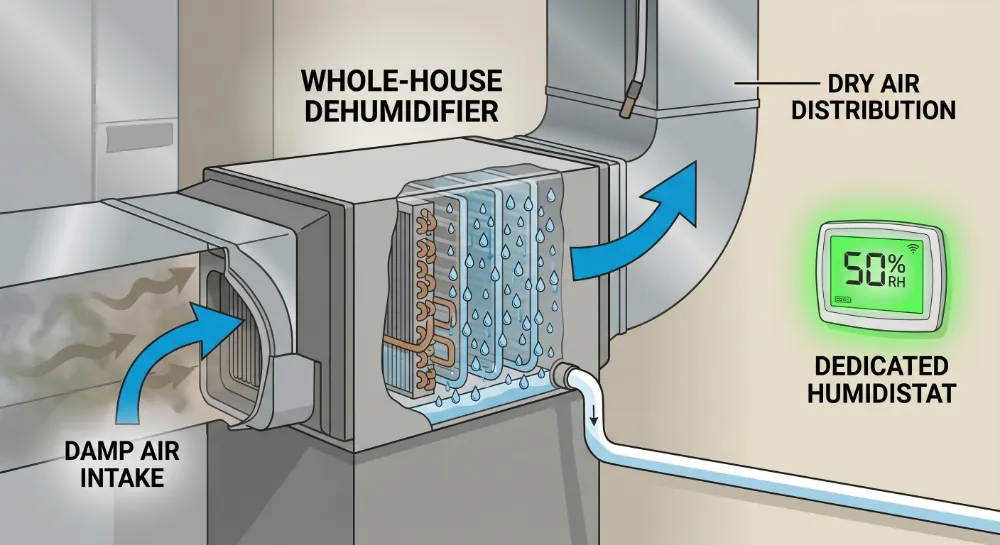
It pulls humid air in, removes moisture, drains that water away, and sends drier air back into the home.
The key advantage is that it can run based on humidity, not temperature.
That means it can dry the house on a mild 65-degree day without forcing your central AC to run when cooling is not really needed.
Depending on the home, a whole-house dehumidifier may be connected to existing ductwork or installed with its own dedicated ducting. It also needs proper condensate drainage, because the water it removes from the air has to go somewhere safely.
Why Installation Details Matter
A whole-house dehumidifier is not just a plug-in appliance. It needs to be sized, ducted, drained, and controlled correctly.
Important installation details include:
- Where the system pulls humid air from
- Where it sends dry air back into the home
- Whether it can run independently from the main HVAC blower
- How the condensate drain is routed
- Whether a pump is needed
- Whether a secondary drain pan and float switch are needed in attic installations
- How the system affects airflow and pressure in the home
This is where professional design matters. Poor ducting can reduce performance, create airflow problems, or cause the system to short-circuit its own air.
For homes with gas appliances, airflow changes can also affect pressure inside the home. In some cases, combustion safety testing may be needed to make sure vented appliances continue to exhaust properly.
Older New Hampshire Homes Often Need Extra Moisture Control
Many New Hampshire homes were built long before modern air sealing, drainage, and HVAC design practices.
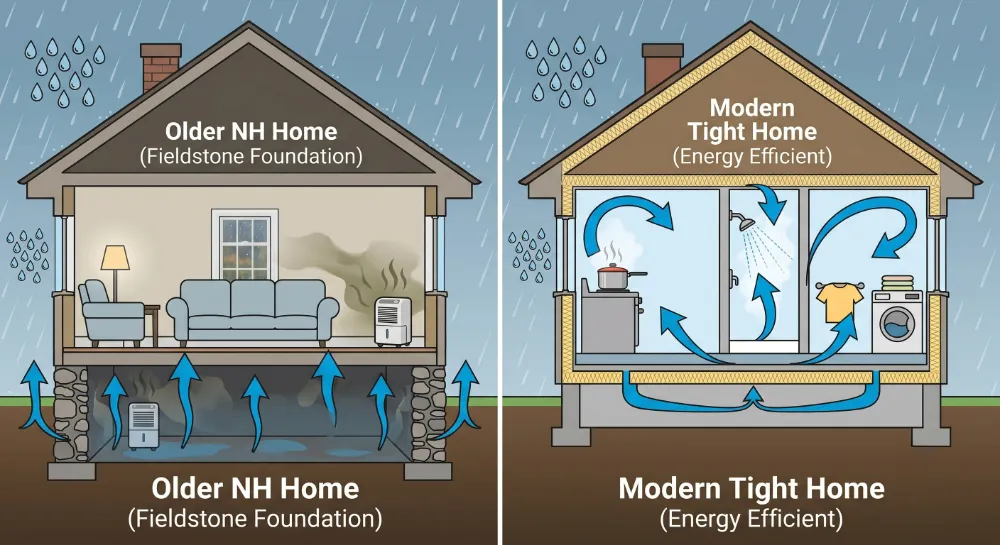
Older basements can be a major source of moisture. Fieldstone, granite, block, and older concrete foundations can allow ground moisture to move into the basement air. Once that damp air is inside, it can travel upward through the house.
That is one reason a second-floor bedroom or main living area can feel humid even when the moisture problem starts in the basement.
In these homes, humidity control is not just about comfort. It can help protect wood framing, flooring, stored belongings, and indoor air quality.
Newer Tight Homes Can Have Humidity Problems Too
Newer homes can have the opposite problem.
They are often built tighter and insulated better, which is great for energy efficiency. But tighter homes can also trap moisture from cooking, showers, laundry, breathing, and everyday living.
Because these homes do not heat up as quickly, the AC may not run long enough to remove humidity.
The result is a newer home that is efficient, but still feels damp during mild weather.
A whole-house dehumidifier can help separate moisture control from cooling, which is often exactly what tight homes need.
Can a Whole-House Dehumidifier Help in Summer Too?
Yes.
Dryer air feels more comfortable than damp air. When humidity is controlled, many homeowners can feel comfortable at a slightly higher thermostat setting.
That can reduce how hard the AC has to work during peak summer weather.
In other words, a whole-house dehumidifier can help in two ways:
It handles damp spring and fall weather when AC is not the right tool.
It supports the AC in summer by reducing the moisture load.
That can improve comfort and may help reduce unnecessary wear on the cooling system.
When to Call Al Terry
Call Al Terry if your home feels damp, sticky, or musty even when the temperature seems normal.
A professional can check:
- Indoor humidity levels
- AC run times and short cycling
- Airflow issues
- Basement moisture sources
- Ductwork layout
- Condensate drainage
- System sizing
- Whether a whole-house dehumidifier makes sense
Sometimes the answer is maintenance. Sometimes it is airflow. Sometimes it is a drainage or basement moisture issue. And sometimes the home really does need dedicated dehumidification.
The important thing is to diagnose the cause before relying on the AC to solve a problem it may not be built to handle.
The Bottom Line
If your New Hampshire home feels sticky when it is not hot outside, your AC may not be the real problem.
The issue may be humidity.
During spring and fall, mild temperatures can keep your air conditioner from running long enough to dry the air. Running AC in cool weather can also create cold, clammy comfort and unnecessary equipment stress.
A whole-house dehumidifier gives your home a dedicated way to control moisture without overcooling the space.
For many New Hampshire homes, especially older homes with damp basements or newer homes with tight construction, that can make the difference between a house that simply has the right temperature and a house that actually feels comfortable.
If your home feels damp, sticky, or musty, contact Al Terry Plumbing, Heating & Cooling to schedule an indoor comfort evaluation.
More Practical Home Advice You Can Trust
Our homes face unique challenges in New Hampshire’s climate. These articles break down heating, plumbing, and electrical topics in plain language—helping you understand what matters, what can wait, and how to protect your home through every season.
Why Your Home Feels Sticky When It Is Not Hot Outside
New Hampshire weather has a way of confusing your home’s comfort system One day it is cool enough to leave the windows closed. The next day the house feels damp, sticky, and uncomfortable — even though the thermostat says it is only 68 or 70 degrees inside. That is one of the most common shoulder-season…

Why Your Upstairs Is Always Hotter Than the Living Room
If you own a two-story Colonial in southern New Hampshire, this may sound familiar: The living room feels fine. The thermostat says the AC is working. But the upstairs bedrooms are still warm, sticky, and uncomfortable. By bedtime, the second floor can feel 6, 8, or even 10 degrees hotter than the first floor. The…
Ductless Mini-Splits for Older NH Homes Without Ductwork
Older New Hampshire homes have a lot of character. They also have a comfort challenge. Many Colonials, Capes, farmhouses, and mid-century homes were built around boilers, radiators, or hot-water baseboard heat. Those systems can keep a home warm, but they were not designed for central air conditioning. In many older homes, there simply is not…
Outdoor GFCI Outlets: Why Weatherproof Protection Matters for NH Homes
Outdoor power is something most homeowners use without thinking much about it. You plug in holiday lights. Run a power washer. Charge yard tools. Power patio speakers. Use landscape lighting. Maybe you have an outdoor kitchen, pool equipment, irrigation controls, or smart devices around the house. But outdoor electricity has to deal with conditions indoor…
Why NH Pollen Is Hitting Your HVAC System Harder This Year
If it feels like pollen season is worse than usual this spring, you’re not imagining it. Across New Hampshire, homeowners are dealing with heavy tree pollen from oak, maple, and ash. Most people think of pollen as an allergy problem. Sneezing, itchy eyes, congestion. But what many homeowners do not realize is that pollen can…
Should You Shut Your Boiler Off for Spring in NH?
When the weather starts warming up in New Hampshire, a lot of homeowners start asking the same question: Should I shut my boiler off for the season, or leave it running? The honest answer is that it depends on your system. For many homes, mid-to-late April is the right time to stop using the heating…

Tired of High Electric Bills in Southern NH? Start With These Smart Upgrades
If your electric bill in Southern New Hampshire has been climbing, you are not imagining it. Between high regional electricity costs, older homes that leak heated or cooled air, and HVAC systems working harder than they should, many homeowners are paying more every month than necessary. The good news is that lowering your bill does…
Low Water Pressure in Spring? 5 Plumbing Problems NH Homeowners Shouldn’t Ignore
When spring finally shows up in New Hampshire, most homeowners are ready to open windows, clean up the yard, and put winter behind them. But for your plumbing system, spring can be one of the toughest times of year. As frost leaves the ground, snowmelt saturates the soil, municipal crews begin hydrant flushing, and aging…

How Your HVAC and Plumbing Systems Can Help Fight Spring Allergies
Spring is a welcome change in Southern New Hampshire. The snow melts, the windows start to open, and the air finally feels lighter. But for many homeowners, spring also brings sneezing, congestion, itchy eyes, and poor indoor air quality. Most people think of spring allergies as an outdoor problem. In reality, your home’s HVAC and…
Why March Is the Smartest Time to Service Your AC in New Hampshire
Why March Is the Smartest Time to Service Your AC in New Hampshire Most homeowners in New Hampshire do not think about air conditioning in March. They are still thinking about snowbanks, muddy driveways, and one more spike in the heating bill. But that is exactly why March is such a smart time to look…

Our Commitment to Your
PEACE OF MIND
5-year warranty on all new installations
AND 2-year warranty on all repairs!