
 Get Pre-Qualified
 603.485.4205
  24/7 Emergency Service Request
 Well Water Season: Should Your NH Home Get a Summer Water Test?
For many New Hampshire homeowners, well water is part of everyday life. You turn on the tap, fill a glass, run the shower, water the garden, and assume the water coming from your private well is safe.
But unlike town or city water, private wells are not monitored by a municipal water department. That responsibility belongs to the homeowner.
That makes summer an important time to think about water quality.
Between dry spells, sudden heavy rain, lawn treatments, septic activity, and increased outdoor water use, summer can change what is happening underground around your well. Even if your water looks clear and tastes normal, contaminants may still be present.
So, should your New Hampshire home get a summer water test?
For many private well owners, the answer is yes — especially if it has been a few years since your last full test, you recently bought the home, you have young children, or you have noticed changes in taste, odor, staining, or water pressure.
Why Summer Can Be Tough on Private Wells
Private wells pull water from underground aquifers. That water is affected by the soil, bedrock, weather, nearby septic systems, and land use around your property.
In summer, a few things can raise the risk of water quality problems.
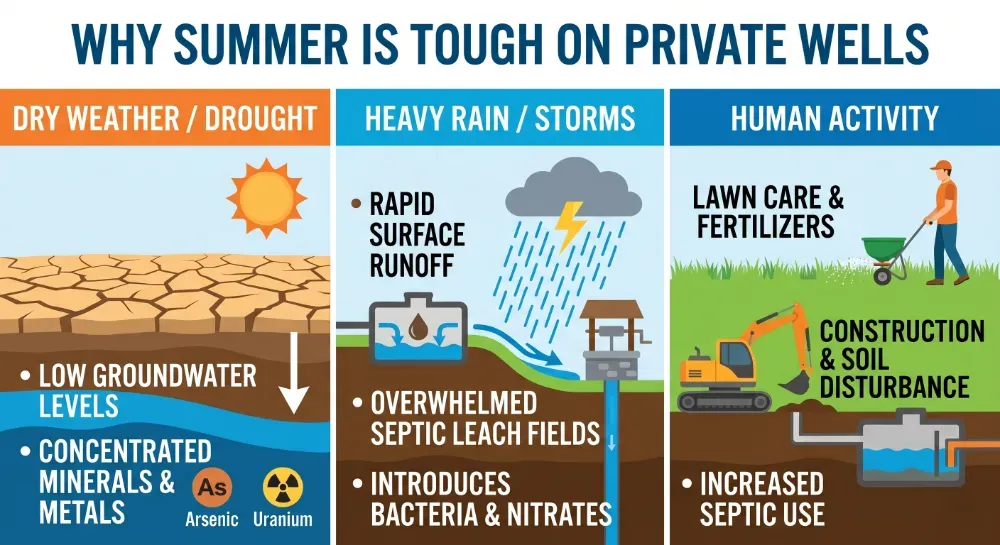
Dry Weather Can Concentrate Certain Contaminants
During dry stretches, groundwater levels can drop. When there is less water in the aquifer, naturally occurring minerals and metals may become more concentrated.
In New Hampshire, some of the biggest concerns include:
- Arsenic
- Uranium
- Radon in water
- Manganese
- Iron
- Other minerals from local bedrock
These contaminants do not always change the taste, smell, or appearance of your water. That is one reason testing matters.
A well that tested fine years ago may not always stay that way, especially after seasonal changes, drought conditions, construction nearby, or changes in water use.
Heavy Rain Can Push Contaminants Toward the Well
Summer rain can come fast and hard. A sudden downpour may overwhelm soil, drainage areas, or nearby septic leach fields.
When that happens, surface water and runoff can move more quickly through the ground. If a well is shallow, poorly sealed, damaged, or located close to a septic system, contaminants may be able to reach the water supply.
Common concerns after heavy rain include:
- Total coliform bacteria
- E. coli
- Nitrates
- Nitrites
- Runoff from fertilizers or animal waste
Bacteria problems can show up quickly and may create a health risk, especially for children, older adults, and anyone with a weakened immune system.
Lawn Care, Construction, and Septic Work Can Also Matter
Summer is also the season for landscaping, excavation, road work, new construction, septic service, and fertilizer use.
Any activity that disturbs soil or changes drainage can affect groundwater movement. In some cases, new pathways can form underground, allowing contaminants to move toward a well that previously tested clean.
That does not mean every summer project creates a water problem. It does mean well owners should pay attention after major property work, nearby development, flooding, or septic issues.
What Should NH Homeowners Test For?
A good private well test should go beyond taste, hardness, or staining.
Basic in-home screenings from water treatment companies may be useful for understanding hardness, iron, pH, or mineral staining, but those tests usually do not cover the most important health-related contaminants.
For private wells in New Hampshire, a more complete water test often includes:
- Total coliform bacteria
- E. coli
- Nitrate
- Nitrite
- Arsenic
- Lead
- Copper
- Uranium
- Radon in water
- Manganese
- Iron
- Sodium
- Chloride
- Fluoride
- Hardness
- pH
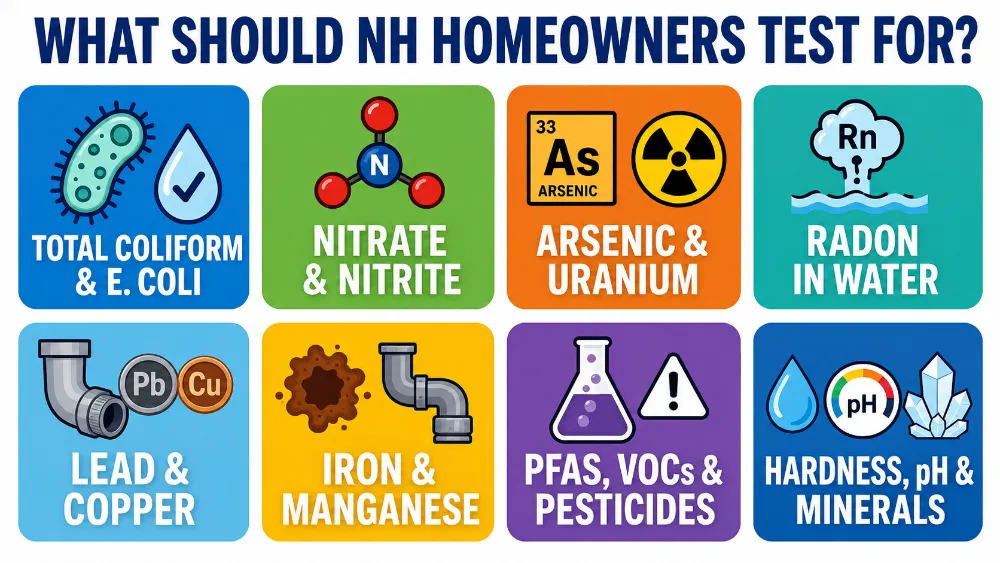
Some homes may also need testing for PFAS, VOCs, pesticides, or other contaminants depending on location, nearby land use, or previous water test results.
How Often Should You Test Your Well Water?
A good rule of thumb is this:
Test bacteria, nitrate, and nitrite every year.
These contaminants can change quickly because they are tied to weather, runoff, septic conditions, and seasonal activity.
A more complete well water analysis should generally be done every few years, or sooner if something changes.
You should also consider testing after:
- Buying a home with a private well
- Installing a new pump
- Repairing the well
- Performing major plumbing work
- Flooding or heavy storm runoff
- Nearby construction or blasting
- Septic system problems
- A noticeable change in taste, smell, color, or staining
- A new baby or young child living in the home
- A long period without using the water system
If you are unsure when the well was last tested, it is usually safer to start with a current baseline test.
Do Not Rely on Taste Alone
One of the biggest mistakes homeowners make is assuming clear water means safe water.
Some contaminants create obvious clues. Iron may cause orange staining. Manganese may leave dark staining. Hard water can leave scale on fixtures. Sulfur can create a rotten egg smell.
But many health-related contaminants may have no obvious warning signs.
Arsenic, uranium, radon, nitrates, PFAS, and bacteria may be present even when the water looks normal.
That is why lab testing is different from simply checking whether the water tastes good.
Accredited Lab Testing vs. Free Water Tests
Many homeowners have seen offers for free water testing. These can be helpful, but it is important to understand what they usually measure.
A free in-home screening often checks things like:
- Hardness
- pH
- Iron
- Manganese
- Total dissolved solids
- Chloride
- Alkalinity
Those results can help size equipment such as a water softener, iron filter, or pH neutralizer.
But free screenings typically do not test for many of the contaminants that affect health, such as arsenic, uranium, radon, PFAS, E. coli, or lead.
For health-related testing, homeowners should use a qualified laboratory. A certified lab can provide the accurate results needed to understand what is actually in the water and what type of treatment may be appropriate.
What Happens If Your Well Water Test Finds a Problem?
A bad water test can feel stressful, but it does not always mean the well is unusable. It means the problem needs to be identified and treated correctly.
The right solution depends on what the test finds.
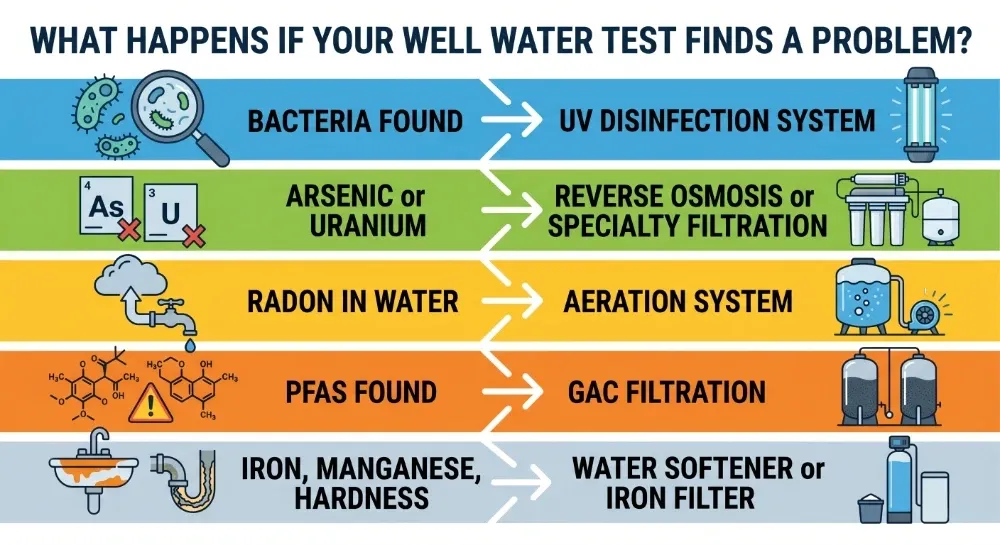
If Bacteria Is Present
If total coliform or E. coli is detected, the well may need disinfection, further inspection, and possible repairs. In some cases, a UV disinfection system or chlorination system may be recommended.
It is also important to understand how bacteria got into the system. A damaged well cap, poor grading, shallow casing, or nearby septic issue may need attention.
If Arsenic or Uranium Is Present
Arsenic and uranium require targeted treatment. Depending on the levels and the rest of the water chemistry, solutions may include specialty filtration, ion exchange, adsorption media, or point-of-use reverse osmosis.
This is not something to guess at. The treatment should match the water test results.
If Radon Is Present in Water
Radon in well water can be released into the air when water is used for showering, laundry, or dishwashing. If levels are elevated, treatment may include aeration or other specialized systems.
Because radon can also enter a home through the foundation, homeowners may need to understand both air and water radon levels before choosing the best solution.
If PFAS Is Present
PFAS treatment often requires granular activated carbon or specialized ion exchange systems. These systems need proper sizing, installation, and maintenance to stay effective.
If Iron, Manganese, Hardness, or pH Are Problems
These may be considered aesthetic or plumbing-related issues, but they still matter. High iron, manganese, hardness, or corrosive water can stain fixtures, damage appliances, reduce water heater performance, or interfere with other treatment equipment.
In many homes, treatment has to be staged correctly. For example, iron or hardness may need to be addressed before water reaches a UV system, reverse osmosis membrane, or specialty contaminant filter.
Why Maintenance Matters After Treatment Is Installed
Installing a water treatment system is not the end of the story.
Filters need replacement. UV bulbs need service. Salt tanks need attention. Media tanks may need maintenance. Some systems require periodic lab testing to confirm they are still working.
If maintenance is ignored, a system can lose effectiveness. In some cases, contaminants can break through the filter and reach the tap again.
That is why homeowners should keep a schedule for:
- Filter changes
- Annual system checks
- Post-treatment water testing
- UV lamp replacement
- Salt or chemical feed maintenance
- Water pressure and flow checks
Good water treatment is not just about installing equipment. It is about keeping that equipment working.
Signs You Should Schedule a Water Test
Consider testing your well water if you notice:
- A change in taste or odor
- Cloudy, rusty, yellow, or dark water
- Orange or black staining on fixtures
- Scale buildup on faucets or appliances
- Recurring stomach illness in the household
- A new baby or young child in the home
- Recent flooding or heavy runoff
- Septic system problems
- Nearby construction or excavation
- A well cap that is damaged, loose, or below grade
- Water that has not been tested in several years
Even without obvious signs, routine testing is still the best way to know what is in your water.
The Bottom Line for NH Well Owners
If your New Hampshire home uses a private well, summer is a smart time to think about water quality.
Dry weather can concentrate naturally occurring contaminants. Heavy storms can increase the risk of bacteria and runoff. Lawn care, construction, septic activity, and seasonal groundwater changes can all affect what reaches your well.
A professional water test gives you real information instead of guesswork.
For homeowners, that means better decisions, safer drinking water, and the right treatment plan if a problem is found.
If you have not tested your well water recently, or if you are concerned about changes in your water, Al Terry Plumbing, Heating, HVAC & Electrical can help you understand what steps to take next and what type of water treatment may be appropriate for your home.
More Practical Home Advice You Can Trust
Our homes face unique challenges in New Hampshire’s climate. These articles break down heating, plumbing, and electrical topics in plain language—helping you understand what matters, what can wait, and how to protect your home through every season.
Well Water Season: Should Your NH Home Get a Summer Water Test?
For many New Hampshire homeowners, well water is part of everyday life. You turn on the tap, fill a glass, run the shower, water the garden, and assume the water coming from your private well is safe. But unlike town or city water, private wells are not monitored by a municipal water department. That responsibility…
Why Your Home Feels Sticky When It Is Not Hot Outside
New Hampshire weather has a way of confusing your home’s comfort system One day it is cool enough to leave the windows closed. The next day the house feels damp, sticky, and uncomfortable — even though the thermostat says it is only 68 or 70 degrees inside. That is one of the most common shoulder-season…

Why Your Upstairs Is Always Hotter Than the Living Room
If you own a two-story Colonial in southern New Hampshire, this may sound familiar: The living room feels fine. The thermostat says the AC is working. But the upstairs bedrooms are still warm, sticky, and uncomfortable. By bedtime, the second floor can feel 6, 8, or even 10 degrees hotter than the first floor. The…

Ductless Mini-Splits for Older NH Homes Without Ductwork
Older New Hampshire homes have a lot of character. They also have a comfort challenge. Many Colonials, Capes, farmhouses, and mid-century homes were built around boilers, radiators, or hot-water baseboard heat. Those systems can keep a home warm, but they were not designed for central air conditioning. In many older homes, there simply is not…
Outdoor GFCI Outlets: Why Weatherproof Protection Matters for NH Homes
Outdoor power is something most homeowners use without thinking much about it. You plug in holiday lights. Run a power washer. Charge yard tools. Power patio speakers. Use landscape lighting. Maybe you have an outdoor kitchen, pool equipment, irrigation controls, or smart devices around the house. But outdoor electricity has to deal with conditions indoor…
Why NH Pollen Is Hitting Your HVAC System Harder This Year
If it feels like pollen season is worse than usual this spring, you’re not imagining it. Across New Hampshire, homeowners are dealing with heavy tree pollen from oak, maple, and ash. Most people think of pollen as an allergy problem. Sneezing, itchy eyes, congestion. But what many homeowners do not realize is that pollen can…
Should You Shut Your Boiler Off for Spring in NH?
When the weather starts warming up in New Hampshire, a lot of homeowners start asking the same question: Should I shut my boiler off for the season, or leave it running? The honest answer is that it depends on your system. For many homes, mid-to-late April is the right time to stop using the heating…

Tired of High Electric Bills in Southern NH? Start With These Smart Upgrades
If your electric bill in Southern New Hampshire has been climbing, you are not imagining it. Between high regional electricity costs, older homes that leak heated or cooled air, and HVAC systems working harder than they should, many homeowners are paying more every month than necessary. The good news is that lowering your bill does…
Low Water Pressure in Spring? 5 Plumbing Problems NH Homeowners Shouldn’t Ignore
When spring finally shows up in New Hampshire, most homeowners are ready to open windows, clean up the yard, and put winter behind them. But for your plumbing system, spring can be one of the toughest times of year. As frost leaves the ground, snowmelt saturates the soil, municipal crews begin hydrant flushing, and aging…

How Your HVAC and Plumbing Systems Can Help Fight Spring Allergies
Spring is a welcome change in Southern New Hampshire. The snow melts, the windows start to open, and the air finally feels lighter. But for many homeowners, spring also brings sneezing, congestion, itchy eyes, and poor indoor air quality. Most people think of spring allergies as an outdoor problem. In reality, your home’s HVAC and…

Our Commitment to Your
PEACE OF MIND
5-year warranty on all new installations
AND 2-year warranty on all repairs!